Behind the scenes#
Who the cartridge says made Kanadeeru, what the study's second-hand cartridge held, what was left unfinished in the program, the two add-ons it saves to, and how the study behind this guide was done.
The title card and the staff roll#
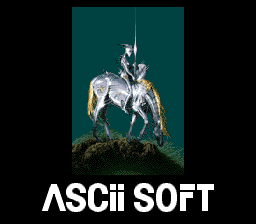

Switched on and left alone, Kanadeeru shows the ASCII SOFT logo (a silver knight on horseback), then its title card, 音楽ツクール かなでーる with two copyright lines, © 1996 ASCII CORPORATION and © 1996 SUCCESS. Then the staff roll scrolls over the title, between the program's two mascots, to the title theme, which is one of the sample songs, タイトルテーマ. When the roll ends, the program goes on to the editor by itself; START goes there at once.
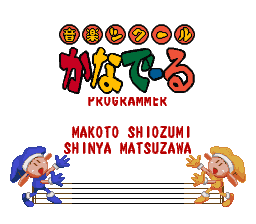
The roll, as the game shows it:
| Role, as the roll gives it | Names |
|---|---|
| PROGRAMMER | Makoto Shiozumi, Shinya Matsuzawa |
| GRAPHIC DESIGNER | Yoshiko Kage, Teruhiko Suzuki |
| LOGO DESIGN | Tsuyoshi Kusano |
| SOUND PROGRAMMER | Shigeharu Isoda |
| DEMO SONG | Kenichi Hirata, Youta Kitagami, Hiromi Fuwa, Mitsuhiro Arisaka |
| SPECIAL THANKS | Yoshiyuki Abe, Yasue Anai, Kouji Saitou, Shinya Kawamura |
| DIRECTOR | Hiroyuki Yasui, Mitsuhiro Arisaka |
| SUPER VISOR | Takato Yoshinari, Yutaka Aoyama, Daizaburou Takami |
| PRODUCER | Atsushi Kawamura |
The eight sample songs are credited together, to the four DEMO SONG names. Nothing in the ROM says who wrote which: a song block holds a title and nothing else about its making (The sample songs). One name, Mitsuhiro Arisaka, is under both DEMO SONG and DIRECTOR.
What the cartridge says about its making is little more than that. The copyright lines name ASCII and SUCCESS, and nothing in the program says what each did. The cartridge's header names it オンガクツクール, and the save's signature, ASCII MUSIC TOOL1995.11.02 V1.0, dates the save format to 2 November 1995. RPG Tsukuru 2 (RT2) and Super Dante carry their studio's development tag inside the ROM; Kanadeeru carries no such tag, and it shares no program code with either, only RT2's sound (Compared with RT2 and Kanadeeru 2).
The second-hand cartridge#
The study worked from a second-hand cartridge, and its save held one song, ムーン ("Moon"). Who wrote it is not known, and this guide doesn't guess. What is on the cartridge:
- One song of 40 pages, the save's first and only, with room after it for 29 more of the smallest songs.
- ♩=144 in 4/4, drums on two tracks, an electric bass, an organ, a chorus and a short trumpet part, with no lyrics and one repeat round its middle. A third drum track and an eighth track (with the koto chosen) are empty.
- Bars left short. Every track it plays has bars of 120, 144 or 168 ticks where a 4/4 bar is 192: a note or a rest short, which the editor allows. Its 28 such bars are the most of any of the nine songs the study had.
Its tracks one by one, and how it sounds: The sample songs.
It was the study's test data throughout: the first song converted to a memory pack, offered by RT2 as BGM 31 and played by RT2's driver; the song whose two compiled forms, for the editor and for RT2, were compared byte by byte; and, with the save around it, the save that the study's tools put on a Turbo File Twin and a memory pack and the game loaded back into a cartridge, byte for byte.
Left over in the program#
Action 6 is a dialog of the score menu that nothing opens: its opener has no caller. Patched into a copy of the ROM in place of Cut, it opens as a window of garbled tiles over the score menu, because it decompresses the wrong data. Under it lie a 7 × 4 grid of 16-pixel cells, 18 of them live, and two buttons. Every cell does nothing (a bare return), and both buttons close it back to the score menu. It looks like an unfinished picker for the score menu, of symbols or chords perhaps; nothing settles what it was meant to be.
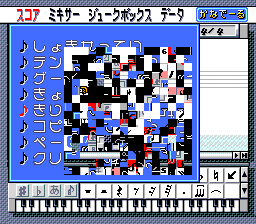
The others:
- The Kanadeeru button at the right of the top bar is a hotspot like the tabs beside it, but its handler is a bare return: clicking it does nothing, on any screen (Getting started).
- Two empty actions,
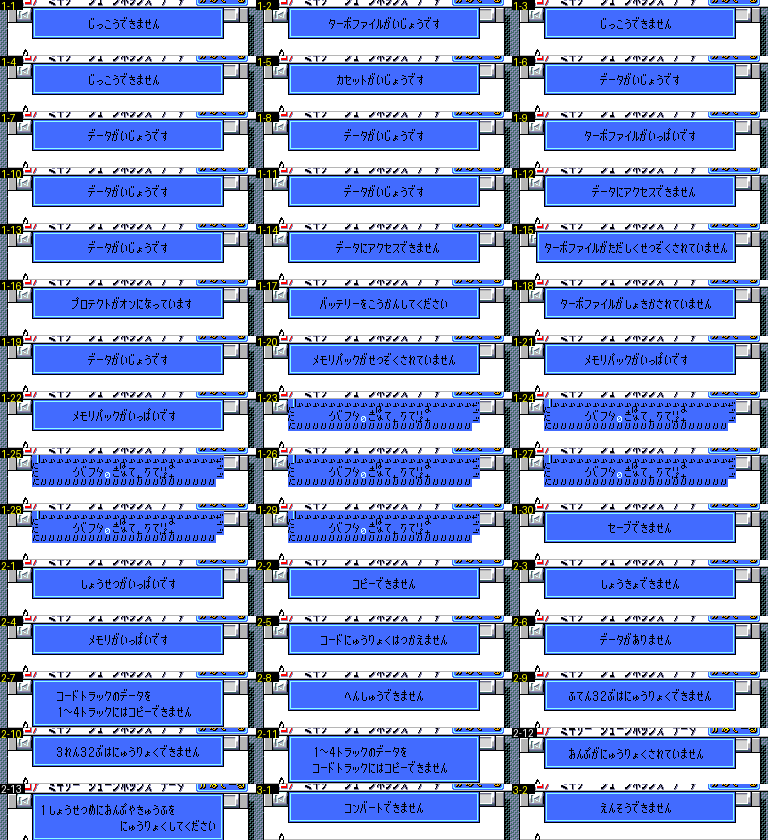
$0Band$1A, in the table of screens. Nothing sets them. - Eight unused messages. Of the program's 45 banner messages, 1-22 to 1-29 are set by no code: 1-22 repeats 1-21's "the memory pack is full", and 1-23 to 1-29 draw their tilemap with the wrong glyph set, as garbage: filler (Limits and messages).
- No debug screen. Every action the table names has been reached or explained, and no other is set anywhere in the code. Button codes at power-on or on the title were not searched for.
A jukebox save that was never written. Kanadeeru 2, the PlayStation successor, saves its jukebox to the memory card, and its program also carries a save title for the first Kanadeeru's jukebox, かなで~るのジュークボックス情報です ("Kanadeeru's jukebox information"). The Super Famicom program saves nothing of its Jukebox.
The storage add-ons#
The cartridge's 32 KB hold the songs. Two add-ons hold more, and each of Save, Load, Delete and Initialise on the Data menu offers them beside the cartridge (Saving and loading).
The Turbo File Twin#
ASCII's Turbo File Twin is a battery-backed box that plugs into the second controller port. Kanadeeru uses it in its STF mode, with the same driver as the other three Super Famicom Tsukuru cartridges. A save there is the whole cartridge, all 32 KB, in one file of 33 blocks named with the save's name, so a Twin holds three. Kanadeeru formats a Twin itself, and its messages about the Twin are the driver's error codes, one message for each. All of this was run in an emulator that has the device, MesenCE; no real Twin has been tried.
The memory pack and the Satellaview#
The cartridge has a slot on top for a Satellaview memory pack, the flash card of Nintendo's satellite-broadcast add-on: eight blocks of 128 KB. Kanadeeru writes two kinds of file there, one a block:
- A save of the whole cartridge (
KANADERU SCORE), up to eight on a pack. - Songs for RPG Tsukuru 2 (
KANADERU CONVERT), from Convert: one file holding the songs converted to it, which RT2 plays as BGM 31 and up. This file is how Kanadeeru's songs reach RT2: Kanadeeru is the tool ASCII made for RT2's custom music, and its ROM holds the template of exactly the file RT2 looks for (Songs for RPG Tsukuru 2).
Each file also carries a tiny boot program, whose text reads BS−Xカセットでは利用できません。 ("this can't be used with the BS-X cartridge"): what the Satellaview would show if asked to start the file.
How this study was done#
Everything in this guide comes from the program itself: there is no manual or guidebook in the project for Kanadeeru, so the guide cites none.
- An emulator run headless. Mesen 2, driven by a script with no window: saved states, memory watched and dumped, screenshots taken from the emulated screen. Every run worked on a copy of a save.
- Clicks without a mouse. Kanadeeru is worked with a pointer, so the scripts click by writing the pointer's position into memory and pressing A. Some clicks did nothing until the study found why: the pointer snaps to the button under it, and the snap had to be cleared with each click.
- A code/data log. The emulator marks each byte of the ROM as code or data as it runs; random clicks from saved states on every screen marked 34,793 bytes of code, which a disassembler written for the project reads.
- The editor as a probe. To learn what a byte means, one control was used on a copy, the song saved, and the battery memory compared before and after; then the code that reads it was found.
- Nine songs as the test. The save's song and the eight samples were each read and packed again byte for byte, and saves written by the study's tools were loaded by the game.
- Patched copies of the ROM reached what no screen reaches: the leftover dialog, and each of the 45 messages, drawn in turn.
- Both programs' menus. The route to RT2 was run as a player of the time would: Convert to a pack, the pack into RT2, its Data page, its BGM settings.
- A second emulator. So that nothing rests on one emulator's quirks, the playback was repeated in bsnes: the compiled song came out byte for byte the same, and the sound driver ticked at the same rate. bsnes's memory-pack slot reads a pack but takes no writes, so the route to RT2 could be run in Mesen only. MesenCE, a fork of Mesen, ran the Turbo File Twin.
- This guide's pictures and sounds are the game's own: the screenshots taken by script in Mesen from power-on, the Jukebox's pictures drawn by the game, and every song and instrument recorded from the game's playback in bsnes.
The work ran as eight steps, each finished with its notes, a tool and a check:
| Step | What it settled | How it was checked |
|---|---|---|
| K1. The program map | The start-up, the main loop and its two modes, the screen scripts, the editor's 27 actions and their hotspot tables, which banks are code | A code/data log of random clicks on every screen: 34,793 bytes of code seen running |
| K2. The save and the song format | The save's header, sum and pages; the song block, its tracks, events, lengths, slurs and repeats; the tempo curve, lyrics and signs; the title and lyric codes | All nine songs packed again byte for byte; a save written by the tool loaded and saved back unchanged |
| K3. The screens | Every screen and dialog, and what each control writes | Screenshots of each; the panels' writes found in memory |
| K4. Songs to RT2 | Convert's MTTC file, field by field, and RT2's side of it | A converted song taken to RT2 through both programs' menus and offered as BGM 31 and played by RT2's driver; the file rebuilt by a tool byte for byte |
| K5. The sound | The sound set and driver against RT2's; the compiler and its two outputs | The nine songs ripped as .spc and run beside the game |
| K6. The pack and the Turbo File | MTSV and the Turbo File file, both the whole cartridge | Each round-tripped in an emulator; the tool's files loaded by the game, byte for byte |
| K7. The rest | The Jukebox, Initial Settings, the tools, every sign code, playback, the limits, the 45 messages, the leftovers, the credits | Each limit reached; each message drawn by the game from a patched copy |
| K8. Summary and a second emulator | The overview and the comparisons with RT2 and Kanadeeru 2; the playback in bsnes | The compiled song byte for byte in both emulators |
What's left open#
Kanadeeru counts as decoded: every format a song is made of is read and written back. These points are not settled:
| Subject | What is not settled |
|---|---|
| The chord track | What track 5's two extra bytes hold in chord mode |
| Events | Event byte 4 (nearly always $20); how a triplet is stored, and the length codes 7–10 and 17 up (no song uses them) |
| Lyrics | Lyric code $CB (a space or a held syllable); codes $28 and $29, unused |
| The song header | Byte +$0F ($C2 in every song); that the Mixer's master fader sets the music volume (+$2D) is from the code only |
| The Mixer | That its controls write the track records' bytes 2–4 is inferred from the bytes and the screen, not measured |
| The sound | Some entries of the sound code's jump table; the sound-effect block, and whether Kanadeeru plays any effect; the path of the test note a click sounds |
| The program | The editor's input path in detail; which data each screen's script reads |
| The Turbo File | What the file code A7 stands for; whether Kanadeeru lists only its own files on a Twin shared with other games |
| The memory pack | The writer's code step by step (the formats come from the bytes and the rebuilds); what RT2's menus do with an MTSV save; that Initialise would erase another program's data at the start of a pack (from the code) |
| The limits | A pack with eight saves and a Twin with three were not filled; a song of eight full tracks could be made but not saved (inferred, not tried) |
| RT2 | A map playing song 31 was not run (the same command that played it in the first test plays it there) |
| A second emulator | The route to RT2 in an emulator other than Mesen (bsnes's pack slot takes no flash commands) |
| Hidden content | Button codes at power-on or on the title were not searched for |
| Kanadeeru 2 | Why some of its notes in the three shared songs sit an octave above the rest |
Fan-made reference material, one of the Eschaton Games Tsukuru guides. Not affiliated with the publishers of the titles it covers.